.png)
A Friendly Feast
Interaction Design: Health & Wellbeing
Washington University
Design Tools
Figma, Illustrator, UX Research, Prototyping
Year
Aug-Oct 2021
Location
St. Louis, MO
My goal for this project was to focus on making those who are food intolerant feel included and safe in social situations. My solutions focused on trying to make others both empathize but also allow people to feel like they are part of a community.


Process
Step 1: Immersion & Research
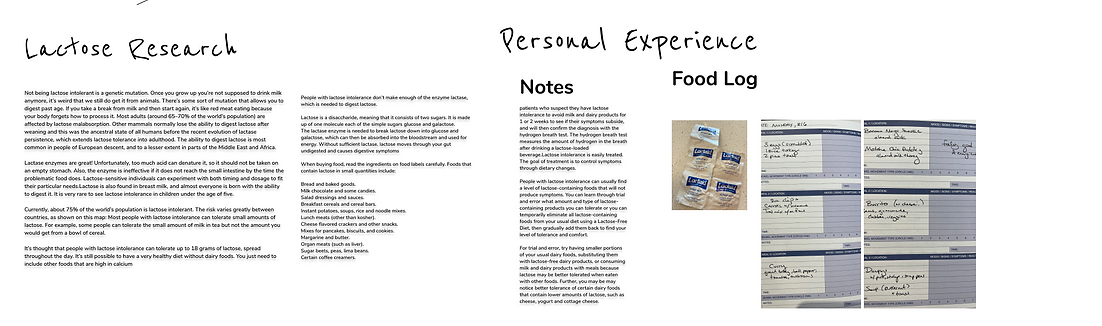
We were given the objective to pick a food intolerance and immerse and research the experience of having that allergy. Given I am already lactose intolerant, I decided to utilize a food journal to document my eating choices and feelings, research lactose intolerance as a whole, and also interview 5 participants who were also lactose intolerant to hear their experience.
Questions for Interviewees:
-
Scale of 1-10 how severe is your intolerance? What happens to your body if consumed?
-
Any specific or funny stories you can think of around your intolerance?
-
What supplemental foods do you consume/how have you changed your life to accommodate your allergy?
-
Taking lactase enzymes or medication?
-
What would have been most helpful when you first realized you were lactose intolerant? What would be helpful even now?
-
When did you realize your intolerance?
-
What supplemental foods do you consume/how have you changed your life to accommodate your allergy?
-
What is your best advice to those who are lactose intolerant?
Step 2: Reframe & Generate Problem
After gathering interview responses, I generated some key insights and my question that I wanted to focus on after making empathy maps and documenting both internal and external experiences of living with an intolerance as a whole.

Stories:
-
Going out and getting dessert (ice cream) makes participant feel left out to watch everyone else
-
Choosing is restaurant can be difficult In groups based on food options (no Italian or American)
Insights
-
Accessibility is important: "I can eat if I have lactaid or my meds". Often, food avoidance is practiced because it is such a hassle.
-
Education is crucial: Some people didn't know they had a food intolerance until someone else told or helped them
-
There is strength in empathy, immersion, and solidarity.
Step 3: Generate Lo-fi Solutions & 1st User Feedback
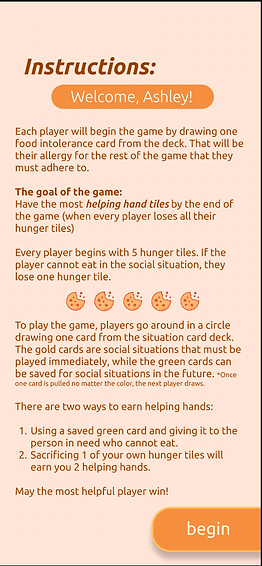
With the new goal of making people feel welcome in social situations, I came up with an idea for a game called "Friendly Feast". This game responds to the specific challenge because it allows other people who have no food intolerances to feel the pain of having one and empathize because it simulates real life. The game also makes people feel included and safe in a fun and educational way. I received great feedback and guidance on what screens for the game could look like and possible scenarios in the game I could develop (ex: helping hands)
Figuring Out the Rules of the Game
-
Goal of the Game: Earn Helping Hands
-
I knew the most important insight from my research was that empathy is key to understanding and compassion. So I made empathy the way a person would win the game: the reward system in the form of helping hand cards. Helping hand cards are ways people can eat and also can inform people of alternatives that are more inclusive. By scoring points, the game is incentivizing an empathetic response and makes players want to help other players.
-
-
Motivation Strategy: Hunger Tiles
-
Hunger tiles serve as a life system in the game and reflects the real life insight that demonstrates how people go hungry when they miss out on social opportunities based around food. It demonstrates the true impact on people and is a way for players to lose the game.
-
-
Immersive Experience: Allergy Cards
-
The allergy cards are ways of both equalizing the playing field and basing the game in real-life, lottery-of-birth circumstance.
-


Lofi Sketches: User Feedback
Overall, feedback was positive and players were excited by the empathetic and fun way of communicating what it is like to live with a food intolerance on a daily basis in a social setting. It is a solution that is more cultural and subconscious, so it does not feel like a blatant, forceful solution. They were interested to see the visual design to be friendly and food-oriented, and wanted situation cards to be more distinguishable from each other.
Step 4: Visual Language & Final User Testing
I then cultivated a brand guidelines and theme for the game itself and developed hi-fi prototypes to present to a group of users and a professional UX designer. Based on feedback, I progressed and built out a functional prototype. I received more feedback on ways the game could improve in the educational aspect.


Feedback:
-
If I were to develop the game further, I could include little facts about certain food situations such as having a an ice cream night but it might affect someone who has a nut allergy because of cross-contamination of certain flavors.
-
Simplicity is always the best. If I have buttons on the screen to progress the game, then those need to be the most highly contrasted and clear thing on the screen to keep motion and interaction easiest.
-
I chose to go with the middle wireframe based on the feedback included from user testing on the left, because it was the most intuitive.

Step 5: Final Functional Prototype
After several rounds of user testing, I finalized the prototype within Figma. I am proud that the end product truly addresses the main goal of making those who are food intolerant feel safe and included socially, because it allows others to empathize, find ways to help, and play around with a new experience.
